Rebekah Stevens leads Care Transformation at Honor. Before moving into product, she ran 24/7 care operations. Her method is grounded in the work: define the problem, test the system against strong operators, learn from the disagreements, and protect the moments where human judgment matters.
“Clients are unhappy” is a concern, not an objective. Name the observable outcome, time window, exceptions, and tradeoffs before choosing a tool.
“AI models are gonna optimize for whatever you tell it to optimize for. And so if you’re not precise in how you define it, you’re gonna end up with some really weird edge cases.”Rebekah Stevens · episode edit · 15:30
Try this: Ask three operators to define “good.” If you get three answers, you have definition work to do.
02 · TEST
Make the model earn the operator’s chair.
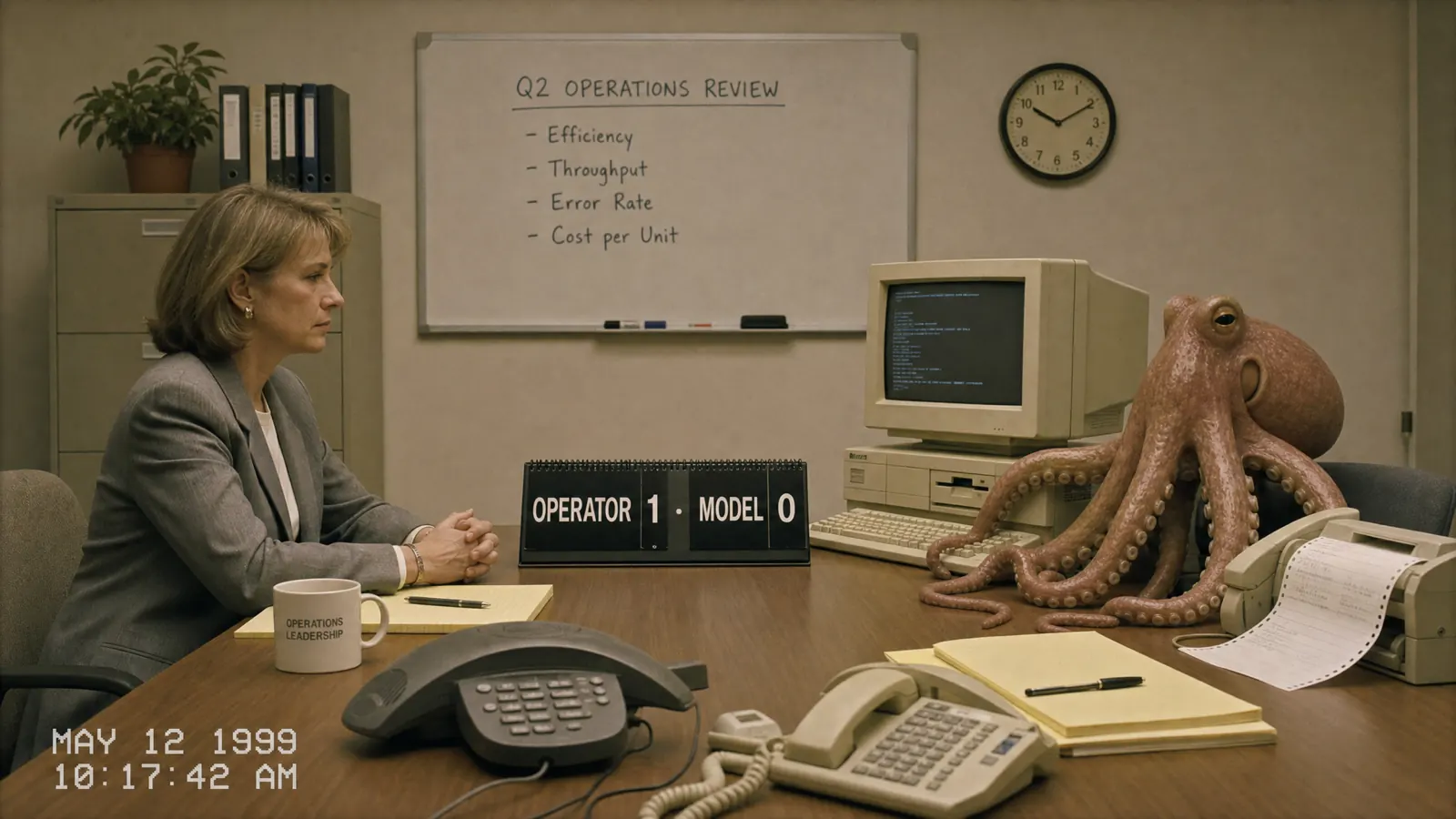
Run the system beside a strong operator before it runs the operation. Score both against the same outcome. Treat every disagreement as evidence.
“But over time, the model started to catch up because we would compete and then we would go audit the results.”Rebekah Stevens · episode edit · 17:50
Try this: Give ten recent cases to the operator and the system independently. Review the differences before automating.
03 · PROTECT
Automate around the human moment.
Let the system read, classify, prepare, and remember. Keep a person in the moments where trust and judgment matter.
“When there is real value in that human touch, you protect that and you use AI in the background to make that human touch better.”Rebekah Stevens · episode edit · 39:30
Try this: Mark each workflow step as automate, prepare, recommend, or keep human.
Working tool
Pressure-test the objective.
Your notes stay in this browser.
Things to try
Three prompts for real operating work.
Bring real examples. Require the model to name what is missing.
01 · DEFINITION
Write the objective function.
Turn the business problem and real cases I provide into an objective-function spec. Define the observable outcome, metric, population, time window, exclusions, tradeoffs, ways the target could be gamed, and the human override. Label every statement observed, inferred, or missing. Ask questions instead of inventing rules. Do not recommend technology until the objective is coherent.
02 · EVALUATION
Design a shadow-mode test.
Design a shadow-mode test between a skilled operator and an AI-enabled workflow. Give both sides the same inputs and scorecard. Include a representative sample, a log for every disagreement, stop conditions, safety boundaries, and criteria for moving to limited use. Keep the operator in control. Treat disagreements as evidence to investigate.
03 · VALET ARTIFACT
Publish an operational objective brief.
Using the notes, examples, and policies I provide, create a one-page Operational Objective Brief and publish it as a private Valet artifact. Include the objective, metric, constraints, edge cases, human override, owner, test plan, open questions, and sources. Distinguish facts, assumptions, and decisions. Exclude secrets and private data. Return the Valet URL and exact access state; keep it private unless I authorize otherwise.
The full conversation
Rebekah Stevens on building technology for operations.